

How “Gladhat” Got Its Name

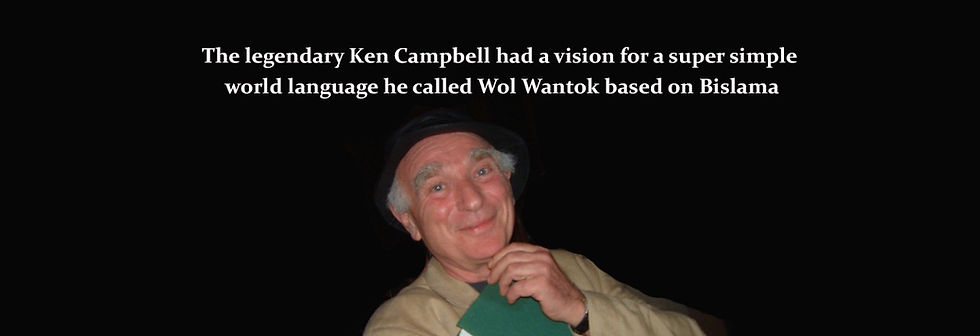
Back in 2001, I was living in London when I went to the West End to see something extraordinary: Macbeth translated into Bislama, or Pidgin English, by the legendary actor and director Ken Campbell.
Bislama is the official language of Vanuatu and is also spoken in Fiji and the Solomon Islands. Its roots are bittersweet. In the late 19th century, Pacific Islanders were taken to Queensland, Australia, as indentured labourers on sugar and cotton plantations. Many had already picked up fragments of broken English from whaling crews and sandalwood traders.
Separated from others who spoke their native languages to prevent them from organising, they developed a shared pidgin. Over time, it spread and solidified into Bislama, with 95% of its vocabulary drawn from English and the rest from French and indigenous words.
The South Pacific Macbeth
A century later, in 1998, Ken Campbell visited the South Pacific. He fell in love with the language, learned it quickly, translated the entire Macbeth, and convinced locals to perform it. In Ken’s translation, the word “gladhat” meant grace, goodness, or kindness.
Ken dreamed of promoting Bislama worldwide as a universal second language, simple enough to learn in just a few days. He called his version Wol Wantok.
"Gladhat" in Bislama means grace, goodness, or kindness.
From Theatre to a Name
The week after the play, I joined Ken’s one-day crash course in Bislama. Some of the actors from the performance were there, including his daughter Daisy. Ken taught through unconventional, brilliant improvisation exercises, the kind of creative chaos that leaves a mark for life.
At one point, he sent us into Camden Town to retrieve rubbish bags from the street and bring them back to the studio under a bookshop. We opened them, one by one, naming everything inside in Bislama — even a pile of rather good clothes.
Twenty-four years later, I still remember blong, from “belongs to” — the single preposition that covers everything in Bislama.
"Hat blong mi blong tebol" means "my hat is on the table."
After the course, I couldn’t stop saying Gladhat Macbeth. Much to my flatmate’s annoyance, it stuck in my head and in my heart. I bought the domain name Gladhat.com.
A Small World Moment
Originally, Gladhat.com was an online art gallery I built with a friend while travelling in Brazil. One day, in Chapada Diamantina in Bahia State, an Israeli woman named Alit joined us. Curious about what we were doing on our laptops, she asked about the name. When I told her, she looked astonished — Ken Campbell had been her teacher too.
The world can feel very small sometimes.
Why I Still Love the Word
Gladhat still carries that original sense of grace, goodness, and kindness. For me, it is also about creative vision and connection across cultures. Ken’s dream of a shared world language hasn’t happened yet. But who knows? If a solar storm ever knocks out Earth’s electronics, something like Wol Wantok might prove more valuable than ever.
If you are curious about Bislama, Ken Campbell, or the communications work I now do under the Gladhat name, here are a few links to explore:



Comments